Research lines
My research focuses on the theoretical design of quantum materials with properties that are hard to find in natural compounds: unconventional superconductivity, symmetry-broken and topological states, unconventional magnetic order, and fractionalized excitations. The work of our group is organized in three research lines:
- Van der Waals quantum materials: designing and engineering exotic phenomena in two-dimensional materials and their heterostructures.
- Quantum many-body physics: exploring the emergence of new physics in interacting, non-Hermitian and ultra-large quantum systems.
- Machine learning quantum materials: developing machine learning algorithms for open problems in quantum matter, in particular learning Hamiltonians from experiments.
The three lines share methods and often the same projects: low-energy and first-principles electronic structure, tensor-network and neural-network many-body solvers, and machine learning models trained on those solvers. A large part of the work is done in collaboration with experimental groups, and the methods we develop are released as open-source software. The papers listed below are a selection of recent work from the group; the complete list is under Publications.
Van der Waals quantum materials
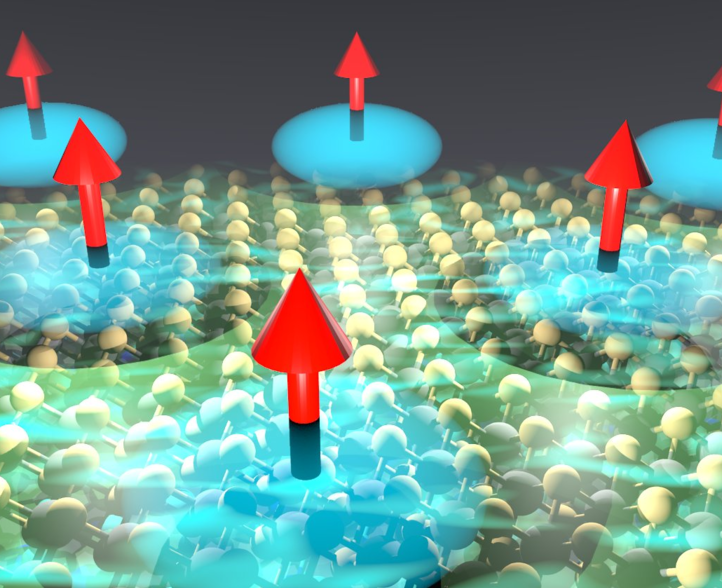
Van der Waals heterostructures make it possible to engineer elusive quantum phenomena through materials engineering, twist engineering and proximity effects. These strategies control the strength of many-body interactions and tailor the internal quantum degrees of freedom, so that states relying on the coexistence of antagonistic electronic orders can be created on demand. We develop theoretical routes to exploit this flexibility, and we work with experimental groups to realize them.
Heavy fermions and Kondo matter
Kondo lattices can be built artificially in van der Waals heterostructures and in twisted multilayers, or found intrinsically in layered rare-earth compounds, giving two-dimensional heavy-fermion states and topological Kondo phenomena.
- Topological zero modes and correlation pumping in an engineered Kondo lattice, Phys. Rev. Lett. 134, 116605 (2025)
- Nature of the unconventional heavy fermion Kondo state in monolayer CeSiI, Nano Lett. 24, 4272 (2024)
- Artificial heavy fermions in a van der Waals heterostructure, Nature 599, 582 (2021)
- Emulating heavy fermions in twisted trilayer graphene, Phys. Rev. Lett. 127, 026401 (2021)
Van der Waals multiferroics
In a two-dimensional multiferroic the magnetic order and the electric polarization are locked to each other, so that one can be controlled through the other. We established the microscopic origin of that coupling in monolayer NiI2 and of the magneto-orbital order of monolayer VCl3, and, with experimental groups, imaged it at the atomic scale. Twisting two multiferroic layers adds moiré textures, such as skyrmion phases and moiré-driven polar order, that the aligned crystal does not have.
- Multicomponent magneto-orbital order and magneto-orbitons in monolayer VCl3, Nano Lett. 25, 4825 (2025)
- Electric field control of moiré skyrmion phases in twisted multiferroic NiI2 bilayers, Nano Lett. 24, 15767 (2024)
- Atomic-scale visualization of multiferroicity in monolayer NiI2, Advanced Materials 36, 2311342 (2024)
- Moiré-driven multiferroic order in twisted CrCl3, CrBr3 and CrI3 bilayers, 2D Materials 10, 025026 (2023)
- Microscopic origin of multiferroic order in monolayer NiI2, 2D Materials 9, 025010 (2022)
Twisted and moiré quantum matter
Twisting or stacking two van der Waals layers creates flat bands and long-wavelength moiré patterns. In graphene multilayers this produces correlated and magnetic states that can be tuned electrically, and in magnet/superconductor heterostructures the moiré modulates the superconducting state into a topological one.
- Moiré-enabled topological superconductivity in twisted bilayer graphene, 2D Materials 11, 035012 (2024)
- Moiré-enabled topological superconductivity, Nano Lett. 22, 328 (2022)
- Spontaneous valley spirals in magnetically encapsulated twisted bilayer graphene, Phys. Rev. Lett. 126, 056803 (2021)
Correlated van der Waals materials
Monolayer dichalcogenides, layered magnets and their heterostructures realize correlated phases that the parent crystal does not show: doped Mott physics, nodal superconductivity, strain-induced topological crystalline order and tunable chiral spin textures. We predict them from the electronic structure and, with experimental groups, resolve them at the atomic scale.
- Observation of tunable chiral spin textures with nonlinear optics, Nature Communications 17, 7576 (2026)
- Strain-induced two-dimensional topological crystalline insulator, Nature Communications 17, 817 (2026)
- Doped Mott phase and charge correlations in monolayer 1T-NbSe2, Phys. Rev. Lett. 134, 046504 (2025)
- Evidence of nodal superconductivity in monolayer 1H-TaS2 with hidden order fluctuations, Advanced Materials 35, 2305409 (2023)
The electronic structure methods behind this line are implemented in pyqula, an open-source library for electronic, interacting and topological properties of tight-binding models.
Quantum many-body physics
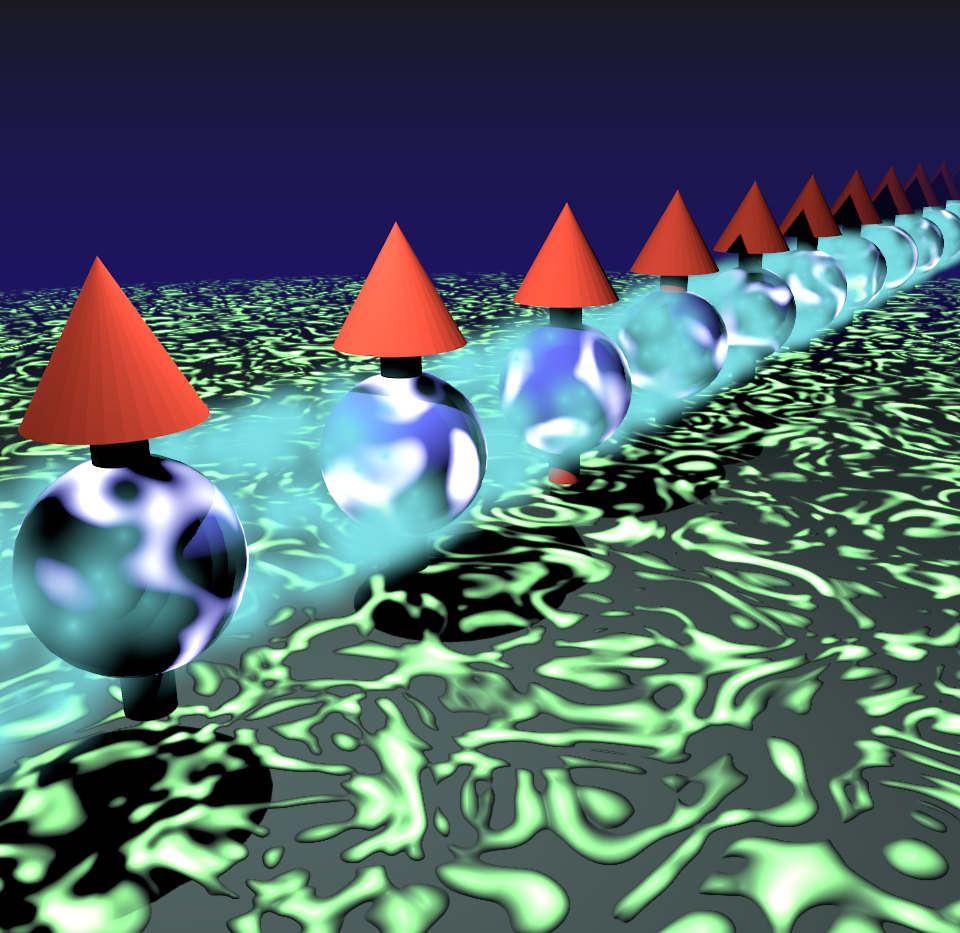
Interactions in strongly correlated systems create behaviors that do not exist in conventional compounds: unconventional superconductivity, correlated topological states, and fractionalized excitations. We explore the quantum matter that emerges in systems with strong many-body interactions, quasiperiodicity, and coupling to an environment. On the methods side, we develop tensor-network algorithms both for interacting models and for single-particle problems too large for any conventional solver.
Quantum inspired algorithms and quantum computing
Moiré, super-moiré and quasicrystalline materials require models with millions to billions of sites. By encoding such Hamiltonians as auxiliary many-body problems, tensor networks solve their spectral, correlated and topological properties at scales orders of magnitude beyond conventional methods. The same many-body tools lead to quantum-circuit algorithms for topological invariants.
- Tensor network method for real-space topology in quasicrystal Chern mosaics, Phys. Rev. Lett. 136, 156601 (2026)
- Solving the Gross-Pitaevskii equation on multiple different scales using the quantics tensor train representation, Phys. Rev. Research 8, 023006 (2026)
- Quantum computing topological invariants of two-dimensional quantum matter, Phys. Rev. Research 6, 043288 (2024)
Non-Hermitian and open quantum matter
Losses and coupling to an environment can create topological modes and criticality that have no Hermitian counterpart. We study non-Hermitian interacting models with tensor networks, and design photonic lattices with engineered losses and quasiperiodic modulation, where these phenomena are observed.
- Topology and criticality in non-Hermitian multimodal optical resonators through engineered losses, Phys. Rev. Research 8, 033132 (2026)
- Observation of non-Hermitian topology from optical loss modulation, Nature Materials 24, 1393 (2025)
- Non-Hermitian topology and criticality in photonic arrays with engineered losses, Phys. Rev. Research 6, 023004 (2024)
- Topological phase diagrams of exactly solvable non-Hermitian interacting Kitaev chains, Phys. Rev. Research 5, L022046 (2023)
- Topological spin excitations in non-Hermitian spin chains with a generalized kernel polynomial algorithm, Phys. Rev. Lett. 130, 100401 (2023)
- Emergence of criticality through a cascade of delocalization transitions in quasiperiodic chains, Nature Physics 16, 832 (2020)
Artificial topological quantum magnets
Spin chains and lattices built atom by atom, or synthesized from molecules on surfaces, realize quantum magnets with topological many-body excitations that can be probed with scanning tunneling spectroscopy.
- Frustration-induced many-body degeneracy in spin-1/2 molecular quantum rings, J. Am. Chem. Soc. 147, 26208 (2025)
- On-surface synthesis of Heisenberg spin-1/2 antiferromagnetic molecular chains, Science Advances 11, eads1641 (2025)
- Phase diagram of the J1-J2 Heisenberg second-order topological quantum magnet, Phys. Rev. Research 7, 013194 (2025)
- Construction of topological quantum magnets from atomic spins on surfaces, Nature Nanotechnology 19, 1782 (2024)
- Real-space imaging of triplon excitations in engineered quantum magnets, Phys. Rev. Lett. 131, 086701 (2023)
The tensor-network methods of this line are implemented in dmrgpy, an open-source library for quantum many-body problems with tensor networks.
Machine learning quantum materials
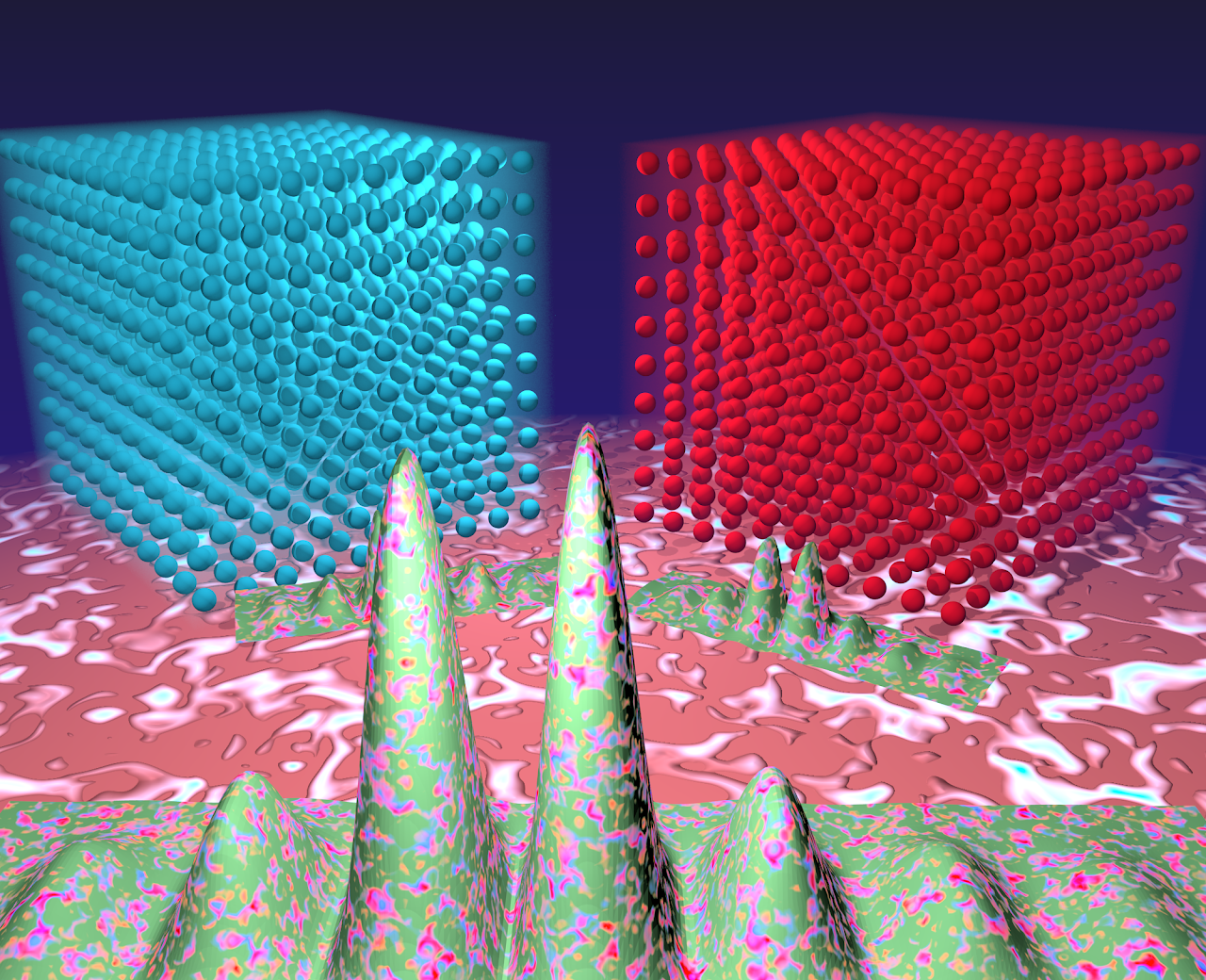
A variety of problems in quantum materials remain out of reach of conventional methods. We develop machine learning algorithms for three of them: inferring the Hamiltonian of a material from experimentally accessible measurements, reconstructing many-body correlations and entanglement from local data, and solving interacting models with neural-network quantum states. Our aim is to bring experimental data and theoretical models together, and several of these methods have already been demonstrated on experiments.
Hamiltonian learning from experimental data
Extracting the Hamiltonian of a quantum magnet or a superconductor from spectroscopy is an inverse problem with no direct solution. We train neural networks on many-body solvers so that they infer the parameters directly from scanning tunneling spectra or impurity states.
- Hamiltonian learning of triplon excitations in an artificial nanoscale molecular quantum magnet, Nano Lett. 25, 13435 (2025)
- Hamiltonian learning quantum magnets with non-local impurity tomography, Phys. Rev. Applied 23, 054077 (2025)
- Hamiltonian learning with real-space impurity tomography in topological moiré superconductors, J. Phys. Mater. 7, 015012 (2024)
- Hamiltonian inference from dynamical excitations in confined quantum magnets, Phys. Rev. Applied 20, 024054 (2023)
Learning correlations, entanglement and quantum criticality
The correlation entropy and the entanglement structure of a many-body state require measuring correlators over a whole sample. Neural networks trained on synthetic data reconstruct them from a few local measurements, transfer between families of Hamiltonians, and, combined with Lee-Yang theory, locate quantum phase transitions from finite systems.
- Transfer learning of many-body electronic correlation entropy from local measurements, Phys. Rev. Applied 24, 054014 (2025)
- Machine learning the Kondo entanglement cloud from local measurements, Phys. Rev. B 109, 195125 (2024)
- Transfer learning from Hermitian to non-Hermitian quantum many-body physics, J. Phys.: Condens. Matter 36, 185603 (2024)
- Lee-Yang theory of quantum phase transitions with neural network quantum states, Phys. Rev. Research 5, 033116 (2023)
- Extracting electronic many-body correlations from local measurements with artificial neural networks, SciPost Phys. Core 6, 030 (2023)
Machine learning for quantum devices and photonic lattices
The same strategy of training on theory and applying to measurements tunes quantum devices and characterizes photonic lattices, in collaboration with the groups that build them.
- Cross-platform autonomous control of minimal Kitaev chains, PRX Intelligence 1, 013005 (2026)
- Machine-learning-enabled characterization of individual ring resonators in integrated photonic lattices, APL Photonics 11, 076124 (2026)
- Adversarial Hamiltonian learning of quantum dots in a minimal Kitaev chain, Phys. Rev. Applied 20, 044081 (2023)
Van der Waals quantum materials
Van der Waals heterostructures make it possible to engineer elusive quantum phenomena through materials engineering, twist engineering and proximity effects. These strategies control the strength of many-body interactions and tailor the internal quantum degrees of freedom, so that states relying on the coexistence of antagonistic electronic orders can be created on demand. We develop theoretical routes to exploit this flexibility, and we work with experimental groups to realize them.
Heavy fermions and Kondo matter
Kondo lattices can be built artificially in van der Waals heterostructures and in twisted multilayers, or found intrinsically in layered rare-earth compounds, giving two-dimensional heavy-fermion states and topological Kondo phenomena.
- Topological zero modes and correlation pumping in an engineered Kondo lattice, Phys. Rev. Lett. 134, 116605 (2025)
- Nature of the unconventional heavy fermion Kondo state in monolayer CeSiI, Nano Lett. 24, 4272 (2024)
- Artificial heavy fermions in a van der Waals heterostructure, Nature 599, 582 (2021)
- Emulating heavy fermions in twisted trilayer graphene, Phys. Rev. Lett. 127, 026401 (2021)
Van der Waals multiferroics
In a two-dimensional multiferroic the magnetic order and the electric polarization are locked to each other, so that one can be controlled through the other. We established the microscopic origin of that coupling in monolayer NiI2 and of the magneto-orbital order of monolayer VCl3, and, with experimental groups, imaged it at the atomic scale. Twisting two multiferroic layers adds moiré textures, such as skyrmion phases and moiré-driven polar order, that the aligned crystal does not have.
- Multicomponent magneto-orbital order and magneto-orbitons in monolayer VCl3, Nano Lett. 25, 4825 (2025)
- Electric field control of moiré skyrmion phases in twisted multiferroic NiI2 bilayers, Nano Lett. 24, 15767 (2024)
- Atomic-scale visualization of multiferroicity in monolayer NiI2, Advanced Materials 36, 2311342 (2024)
- Moiré-driven multiferroic order in twisted CrCl3, CrBr3 and CrI3 bilayers, 2D Materials 10, 025026 (2023)
- Microscopic origin of multiferroic order in monolayer NiI2, 2D Materials 9, 025010 (2022)
Twisted and moiré quantum matter
Twisting or stacking two van der Waals layers creates flat bands and long-wavelength moiré patterns. In graphene multilayers this produces correlated and magnetic states that can be tuned electrically, and in magnet/superconductor heterostructures the moiré modulates the superconducting state into a topological one.
- Moiré-enabled topological superconductivity in twisted bilayer graphene, 2D Materials 11, 035012 (2024)
- Moiré-enabled topological superconductivity, Nano Lett. 22, 328 (2022)
- Spontaneous valley spirals in magnetically encapsulated twisted bilayer graphene, Phys. Rev. Lett. 126, 056803 (2021)
Correlated van der Waals materials
Monolayer dichalcogenides, layered magnets and their heterostructures realize correlated phases that the parent crystal does not show: doped Mott physics, nodal superconductivity, strain-induced topological crystalline order and tunable chiral spin textures. We predict them from the electronic structure and, with experimental groups, resolve them at the atomic scale.
- Observation of tunable chiral spin textures with nonlinear optics, Nature Communications 17, 7576 (2026)
- Strain-induced two-dimensional topological crystalline insulator, Nature Communications 17, 817 (2026)
- Doped Mott phase and charge correlations in monolayer 1T-NbSe2, Phys. Rev. Lett. 134, 046504 (2025)
- Evidence of nodal superconductivity in monolayer 1H-TaS2 with hidden order fluctuations, Advanced Materials 35, 2305409 (2023)
The electronic structure methods behind this line are implemented in pyqula, an open-source library for electronic, interacting and topological properties of tight-binding models.
Quantum many-body physics
Interactions in strongly correlated systems create behaviors that do not exist in conventional compounds: unconventional superconductivity, correlated topological states, and fractionalized excitations. We explore the quantum matter that emerges in systems with strong many-body interactions, quasiperiodicity, and coupling to an environment. On the methods side, we develop tensor-network algorithms both for interacting models and for single-particle problems too large for any conventional solver.
Quantum inspired algorithms and quantum computing
Moiré, super-moiré and quasicrystalline materials require models with millions to billions of sites. By encoding such Hamiltonians as auxiliary many-body problems, tensor networks solve their spectral, correlated and topological properties at scales orders of magnitude beyond conventional methods. The same many-body tools lead to quantum-circuit algorithms for topological invariants.
- Tensor network method for real-space topology in quasicrystal Chern mosaics, Phys. Rev. Lett. 136, 156601 (2026)
- Solving the Gross-Pitaevskii equation on multiple different scales using the quantics tensor train representation, Phys. Rev. Research 8, 023006 (2026)
- Quantum computing topological invariants of two-dimensional quantum matter, Phys. Rev. Research 6, 043288 (2024)
Non-Hermitian and open quantum matter
Losses and coupling to an environment can create topological modes and criticality that have no Hermitian counterpart. We study non-Hermitian interacting models with tensor networks, and design photonic lattices with engineered losses and quasiperiodic modulation, where these phenomena are observed.
- Topology and criticality in non-Hermitian multimodal optical resonators through engineered losses, Phys. Rev. Research 8, 033132 (2026)
- Observation of non-Hermitian topology from optical loss modulation, Nature Materials 24, 1393 (2025)
- Non-Hermitian topology and criticality in photonic arrays with engineered losses, Phys. Rev. Research 6, 023004 (2024)
- Topological phase diagrams of exactly solvable non-Hermitian interacting Kitaev chains, Phys. Rev. Research 5, L022046 (2023)
- Topological spin excitations in non-Hermitian spin chains with a generalized kernel polynomial algorithm, Phys. Rev. Lett. 130, 100401 (2023)
- Emergence of criticality through a cascade of delocalization transitions in quasiperiodic chains, Nature Physics 16, 832 (2020)
Artificial topological quantum magnets
Spin chains and lattices built atom by atom, or synthesized from molecules on surfaces, realize quantum magnets with topological many-body excitations that can be probed with scanning tunneling spectroscopy.
- Frustration-induced many-body degeneracy in spin-1/2 molecular quantum rings, J. Am. Chem. Soc. 147, 26208 (2025)
- On-surface synthesis of Heisenberg spin-1/2 antiferromagnetic molecular chains, Science Advances 11, eads1641 (2025)
- Phase diagram of the J1-J2 Heisenberg second-order topological quantum magnet, Phys. Rev. Research 7, 013194 (2025)
- Construction of topological quantum magnets from atomic spins on surfaces, Nature Nanotechnology 19, 1782 (2024)
- Real-space imaging of triplon excitations in engineered quantum magnets, Phys. Rev. Lett. 131, 086701 (2023)
The tensor-network methods of this line are implemented in dmrgpy, an open-source library for quantum many-body problems with tensor networks.
Machine learning quantum materials
A variety of problems in quantum materials remain out of reach of conventional methods. We develop machine learning algorithms for three of them: inferring the Hamiltonian of a material from experimentally accessible measurements, reconstructing many-body correlations and entanglement from local data, and solving interacting models with neural-network quantum states. Our aim is to bring experimental data and theoretical models together, and several of these methods have already been demonstrated on experiments.
Hamiltonian learning from experimental data
Extracting the Hamiltonian of a quantum magnet or a superconductor from spectroscopy is an inverse problem with no direct solution. We train neural networks on many-body solvers so that they infer the parameters directly from scanning tunneling spectra or impurity states.
- Hamiltonian learning of triplon excitations in an artificial nanoscale molecular quantum magnet, Nano Lett. 25, 13435 (2025)
- Hamiltonian learning quantum magnets with non-local impurity tomography, Phys. Rev. Applied 23, 054077 (2025)
- Hamiltonian learning with real-space impurity tomography in topological moiré superconductors, J. Phys. Mater. 7, 015012 (2024)
- Hamiltonian inference from dynamical excitations in confined quantum magnets, Phys. Rev. Applied 20, 024054 (2023)
Learning correlations, entanglement and quantum criticality
The correlation entropy and the entanglement structure of a many-body state require measuring correlators over a whole sample. Neural networks trained on synthetic data reconstruct them from a few local measurements, transfer between families of Hamiltonians, and, combined with Lee-Yang theory, locate quantum phase transitions from finite systems.
- Transfer learning of many-body electronic correlation entropy from local measurements, Phys. Rev. Applied 24, 054014 (2025)
- Machine learning the Kondo entanglement cloud from local measurements, Phys. Rev. B 109, 195125 (2024)
- Transfer learning from Hermitian to non-Hermitian quantum many-body physics, J. Phys.: Condens. Matter 36, 185603 (2024)
- Lee-Yang theory of quantum phase transitions with neural network quantum states, Phys. Rev. Research 5, 033116 (2023)
- Extracting electronic many-body correlations from local measurements with artificial neural networks, SciPost Phys. Core 6, 030 (2023)
Machine learning for quantum devices and photonic lattices
The same strategy of training on theory and applying to measurements tunes quantum devices and characterizes photonic lattices, in collaboration with the groups that build them.
- Cross-platform autonomous control of minimal Kitaev chains, PRX Intelligence 1, 013005 (2026)
- Machine-learning-enabled characterization of individual ring resonators in integrated photonic lattices, APL Photonics 11, 076124 (2026)
- Adversarial Hamiltonian learning of quantum dots in a minimal Kitaev chain, Phys. Rev. Applied 20, 044081 (2023)